Thursday, April 22, 2010

Musicals, Operas and Home

Last week, we had Broadway director, Robert Johanson on our show. Before the recording started I chatted with him in the greenroom about Monte Cristo, a musical he was directing in Seoul. I felt really homesick talking to him about musicals, operas, and the States.

When the stage was ready, he went out and I sat with the audience and watched the show. He talked about Korean actors and their level of dedication and passion for their work. He was amazed at the level of talent Seoul had. He talked about a lot of other things related to his work and his career, but all I could think about was how much I missed being on stage. I sat there with tears in my eyes. I felt performing was one thing I could not live without. When I was actively practicing and performing, I didn't think much of it. But now that I am not so involved in the musical scene, I feel something vital is missing in my life. I had planned to do a solo recital in Seoul before I went back to the States but I may quit my job a little earlier and audition for something as well. I really miss the stage...

Monday, April 12, 2010

My first day


I got a job as a writer for a talk show called "Heart to Heart" on Arirang TV, a Korean international broadcasting foundation. Today was my first "official" day of work. I had to translate some scripts and attend a post-production editing to make sure everything was in order. I think the best part of the job will be meeting cool, and interesting people. On Wednesday, I'll be "entertaining" a Korean pop singer J.ae before she goes in for a recording session. I also get to find and invite interesting people to bring on the show.

I was afraid that I might be stuck with a job I'd hate for a year but I am glad I found this job (or rather, it found me!). I also like the people I work with. I am surrounded by good people and friends. I feel very blessed. Life is good.

Saturday, April 3, 2010

Remembering the Forgotten War

The 2002 FIFA World Cup was held in Seoul. The entire country was united as one as Koreans ardently rooted for their home team. Millions in red t-shirts joined in cheering the players onto unprecedented success in the history of Korean soccer. Even workaholics put watching games as a priority over work. The media named these obsessively impassioned Koreans the 11th player in the field. Koreans all over the world shared in their victory--except me.


I didn't understand why it was such a big deal for Korea to win. Above all, I didn't understand the mass hysteria they called patriotism. It seemed like Korean people were reveling more in the drama of the event rather than their love for the country. To me, they were swept by collective hypnotism caused by fanatic nationalism. I didn't understand this endemic psyche of the Korean people only until very recently.

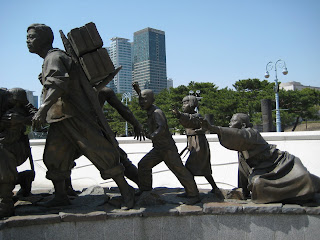
Yesterday, I went to the War Memorial of Korea, a museum that houses the 5000-year history of wars. But because of its chronological proximity to the present time, and the availability of materialistic sources, one-third of the museum was dedicated to the retelling of the Korean War.

My Dad talked about the war often because he saw and lived through its many catastrophic events. He told me the stories of war-orphans, childless mothers, starving people living among piles of rotting corpses. The reality of such a past hit me as I walked through the museum and watched the documentary footage of the war.


The Korean War broke out only 5 years after Korea was liberated from the Imperial Japan who occupied Korea for 35 years. The memories of oppression, and the smell of war are still fresh within the minds of the older generations and their stories are passed onto their children, grandchildren and great-grandchildren. The nascent freedom of the Republic of Korea was bought with the lives of 2 million people in the span of 3 years after the war ended in 1953. An armistice was signed that restored the border between the two Koreas at the 38th parallel and created the Korean Demilitarized Zone (DMZ).

After having walked through the museum, I understood the source of the fervent "madness" with which the Koreans cheered for their team. What brought the Korean people together was not their love for drama, but their bare-knuckled tenacity to unite to survive and triumph. For the first time in my life, I felt my personal history merge with the collective history of the Korean people. It felt as though the blood of its history was running its course through the vein of my ante-natum past.



This is a blood-stained flag that was used to inflame patriotism among Koreans when revolutionaries attempted to free Korea from Japanese imperialism.


During and after the war there were no buildings to hold classes in so students studied outside on the ground.


Books they used


Many survived with only one spoonful of food a day.


Children selling fruits and cigarettes to survive.


People lining up for their ration of food.


So-called "Oink,Oink" porridge. It was made with the thrown-out left-overs by the American soldiers.


The armistice that ended the war

Wednesday, March 24, 2010

Getting naked in Korea - yes me!

I know the title of this post sounds very scandalous. And precisely because of that I know this post is going to get more hits than any of my other posts. But nobody knows who's reading so go ahead and read on.

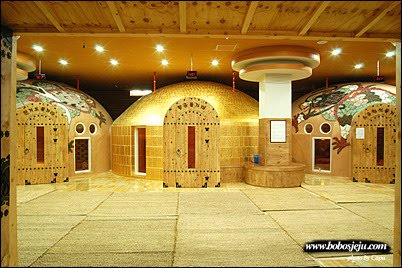
Public bath houses are part of the unique culture of Korea. For your and my edification, I Googled the history of Korean public bath houses. The first Korean public bath house was built in 1924 after the model of Japanese bath houses. Since it was built while Japan occupied Korea, and most likely under the direction of the Japanese leaders, there were far more Japanese customers than Korean. But as time went on, and after the Japanese left Korea in the mid-forties, Koreans continued and developed the bath house culture from a mere place of washing to a place of relaxation, entertainment, and grooming. You can now experience saunas in different temperature,watch TV, sing karaoke, get a facial, a massage, pedicure, manicure, eyelash extensions and other aesthetic services.

Today, the facility is usually divided into two major rooms: the sauna room and the actual bath house. The sauna room is co-ed because you are clothed and has a main space that has karaoke, TV, restaurants and different sauna rooms of different temperature. Some people go there to spend the night because it's open 24 hours and it's so cheap (only $5-8). It's a good place for backpackers to crash to save money.


The bath house is gender-specific and is also equipped with pools of different temperature. It also has showers and little sit-down places to scrub the dead skin off of your body. (Exfoliation is big in Korea)


I have always wanted to experience this new Korean bathhouse but didn't know if I could brave wearing just my birthday suit in public. (I am even shy about wearing my swim suit!)But today I decided that I could. So, my 6-feet-tall American friend Corinna and I went to the bath house this morning. The sauna part was great because we were clothed. Corinna didn't want to stay for the bath part because she didn't want to be stared at. (She is a head, shoulder, chest, and stomach taller than most Koreans.)

So, Corinna went home and I stayed and went into the bath house. I even lay on a table to get my dead skin exfoliated (not just our faces as we normally do but the whole shebang). Needless to say, I felt extremely vulnerable and exposed. So, no more body exfoliation by a stranger. But the whole bath part was doable and I would do it again.

Tuesday, March 23, 2010

White Day resurrected!

My dear friend Sean (pronounced Shon not Shawn. He's from Australia.) read my previous post about my sad White Day. It pained his heart to its core. So, on Saturday, he presented me with a compensatory gift in the form of chocolate covered blueberries! Needless to say, I was one happy lass. Thank you, Sean for putting a smile on my face. :)

Wednesday, March 17, 2010

The mentality of a savior.


A few years ago I attended a conference sponsored by National Asian Pacific American Women's Forum in Los Angeles. One of the workshops I attended addressed the issues of sex slavery, human trafficking,and domestic violence occurring in Asia and to Asian women in the States and what we could do to detect and help these abused women. As we exchanged and discussed different ideas, the leader of the group said something profound that stayed with me ever since: We should not take on the mentality of a savior when we are helping these people.

Whenever we are faced with the sordid reality of abuse, poverty, or injustice, we automatically get on the pedestal of self-righteousness and take on the attitude of a savior. When we see dying children in Africa, or sexually abused women in Asia, or homeless children in Chicago, we say to ourselves 'Here are the victims and I must save them!' Our eyes tear up, we feel genuine compassion, and our hearts reach out to them. We congratulate ourselves for being so sensitive.

I believe that in the process of registering all these emotions we lose a part of ourselves to narcissism. There is a part of us that wants to do good because it makes us feel good and superior. We establish a currency with which we subjugate the victims with our high morality. If good will is used as a surrogate for Prozac, not only do we need less fortunate people to exist, we also lose the opportunity to see these people as our equals. We may unconsciously continue to debilitate them by taking on the role of a savior and reinforcing their sense of helplessness and vulnerability. We are not superior because we had better luck. We are only their partners helping them rebuild themselves. We acknowledge their inner worth and respect them as our equals--as our brothers and sisters in humanity so when they become whole, they can do the same for others.

What really disturbs me is the naivete of some people who visit foreign countries, especially Third World Countries, hand out some money, come back and tell their heroic tales and the unfortunate fate of those whom they helped. Behind these philanthropic stories I hear, "Look what I did for these poor people. Look what a good person I am." To me, helping these people were nothing but glorified camping trips that earned them a pat on the shoulder. Their compassion may have been genuine but the attitude of subtle arrogance and lack of respect and reverence for those who suffer perpetrate ignorance and a false sense of heroism. We are not heroes. We are only fellow travelers of life that were dealt a better hand.

Monday, March 15, 2010

Valentine's Day, White Day, and Black Day

Yesterday was White Day here in Korea. White Day is when boys give girls candy, chocolate, flowers, cards, love, affection, teddy-bears, kisses and blah, blah, blah none of which I got. Valentines Day in Korea is when girls do the same stuff for boys. Anyway, I had a crappy V-Day in America but I knew I had another chance in Korea! But, no. I usually get myself something though, like a bunch of tulips last year, and a butt load of candy and chocolate this year.

I miss the small window of time when I was truly happy being single. I thought I had reached some kind of nirvana. Although I feel in my gut that this is a time for me to be single and concentrate on what's important to me right now, it would be nice to have a quasi-boyfriend to hang out with every now and then.

But until then, I will be eating black noodles on Black Day (kind of like single-awareness day) on April 14.

Ajumma

There is not a direct translation for the word "ajumma" in English but it is used to describe a married woman who lets herself go doing housework. It's not equivalent to "ma'am" because it denotes no particular respect. Maybe, "senora" in Spanish but "ajumma" has a more persistent, stickier subtext like the taste of Korean pepper paste. I am posting a visual aid for further clarification.


The opposite of "ajumma" is "agassi." An "agassi" is an unmarried woman whose business is to look good, young and cultured. Here is another visual aid I found on Google image.


I secretly rejoiced when my married Korean friends would tell stories about how they were called an "ajumma" at a store. Now that I am at an age where it is kosher for my relatives to bluntly ask "Why aren't you married yet?", "When are you going to get married?", "Don't be so picky!" it gives me greater reason to rejoice in their "ajumma-ness." It is at times like this when my hands and feet are tied and am ambushed with questions regarding my inability to get hitched, I think about my ajumma friends and smile (internally). After all, I am still an agassi.

Or so I thought. Last Friday, I went to the immigration office and heard someone calling out, "Ajumma!" I looked around for an ajumma but she couldn't be found so I kept walking. He called out "Ajumma!" again and tapped on my shoulder. He said, "Ajumma, I hope you make a lot of money." I went blank for a few seconds. When my cognitive faculties returned, I thought,"Why is he calling me Ajumma, and why is he telling me to make a lot of money?"

Apparently, there are a lot of Chinese-Koreans (*ethnically Korean, nationally Chinese) who come to the immigration office to get a work visa. He mistook me for a poor Chinese-Korean ajumma looking for work. I wasn't sure how that happened so I went home and thoroughly analyzed my look. I concluded that it was my short permed hair that I gathered in a ponytail. (He did call me Ajumma from behind.) I am just going to chalk it up to the fact that he did not see me from the front because I am still a spring chicken agassi ready to conquer the world!

*A lot of people confuse the meaning of ethnicity and nationality. Let me take a moment to clear up the confusion. Ethnicity is based on the original country from which one can claim her heritage. Nationality is based on the country of citizenship one belongs to. For example, I am ethnically Korean, but nationally American.

Tuesday, March 9, 2010

The mystery of the subway lady

So, I talked to my aunt about my encounter with the lady who refused to take my seat on the subway. She explained that when younger people offer their seats to older people, the older people sometimes refuse because the younger people here lead such stressful, busy lives working or studying that they want them to be able to rest a bit when they can. So, the lady probably didn't want to take away my opportunity to sit and rest. I really hope that is the case.

Sunday, March 7, 2010

Fashion and school

Today was the second week of class. I dressed up a little more than last week although I didn't wear heels. I haven't dressed up like this for school since my first year at Fashion Institute of Design and Merchandising. (Most of you don't know this but once upon a time, I was an aspiring fashion designer.) It's work to have to dress up like this.

Toward the end of my first year at FIDM, I remember feeling so fed up with the commercial, materialistic side of fashion that I decided to go on strike. I stopped wearing make-up, put my hair in a pony-tail, wore jeans, big baggy shirts, and sneakers. I boycotted my own closet. I went to school like this every day among students who patented their looks with a pride of an artist. I was making a statement against excess, materialism, and commercialism. I was embracing my own version of Waldenian transcendentalism in the middle of Los Angeles.

Unfortunately, nobody knew what I was doing. They probably thought the stress and pressure of the business were getting to me as I became increasingly ratty. (I remember a lecturer doing a double take as he passed by me.) Too bad my intentions didn't translate. I left fashion school after that quarter and never looked back.

I am not against looking good but having to dress up to keep up with the Kims, Lees and Parks is not my cup of tea. So, this whole thing about dressing up for school to fit in is going down the drain starting next week. But before this day is over, I must say I am looking pretty dang good right now.

LinkWithin

Related Posts with Thumbnails